
BLOG ARCHIVE

Oak by Simon Baxter | My Photo Bookshelf
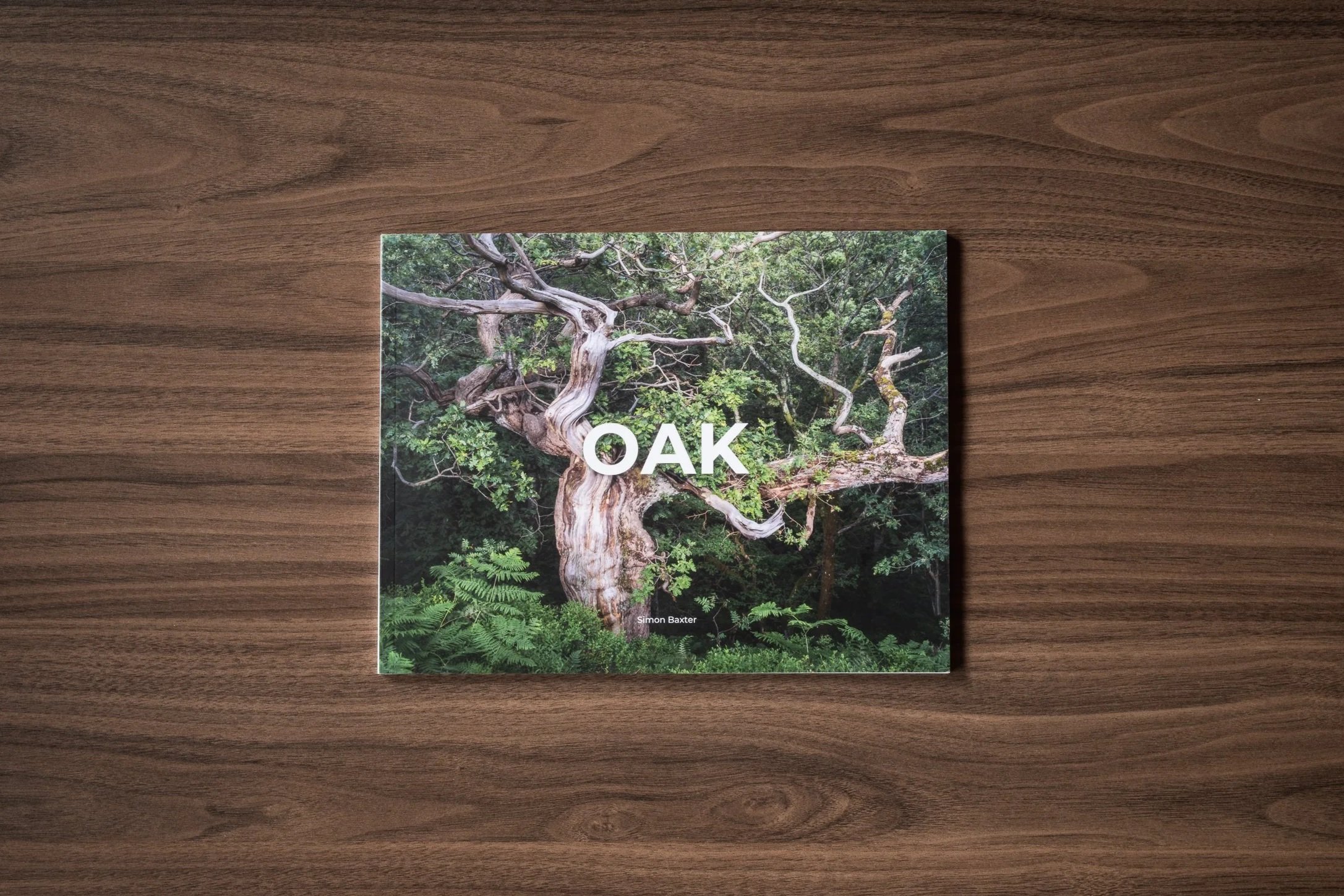
Oak combines stunning woodland images with insightful essays, revealing the depth of Simon Baxter’s connection to this iconic tree.
To many, woodland photography is one of the trickiest landscape genres to master, and in many ways, I’d probably agree. It demands patience, vision and a genuine passion for the subject to create compelling photographs of the woodland. It’s not simply a case of being in the right place in the right conditions; it’s about an internal moment—being in the right frame of mind to notice something beautiful at a particular point in time, when on any other day you might simply walk past without a second glance.
Simon Baxter’s love for the woodland is infectious, and I have to admit that his photography was a major influence on me when I first began turning my own lens towards the trees back in 2019. I bought his first book, Gathering Time, and more recently Woodland Sanctuary, which accompanied an exhibition he created with Joe Cornish. So, when Simon announced he would be releasing Oak earlier this year, I didn’t hesitate—I pre-ordered a copy straight away.
Synopsis
OAK celebrates a very special species of tree that captured Simon’s heart and imagination as he explored his local countryside in North Yorkshire. Captivated by their beauty and richness of life, Simon has discovered and immersed himself in some of the very best oak woodlands his local area has to offer. OAK includes 38 beautiful images that were all made close to home and haven’t appeared in previous publications.
My thoughts about the book
Oak represents a personal photographic study of a single tree species and opens with a brief but engaging history lesson, taking the reader back to the first forests 56 million years ago, followed by an overview of the life of an oak tree. It’s mind-boggling to consider how long an oak can live and the span of historic events that may have unfolded during the lifetime of just one tree.
The book itself is a high-quality 11 x 8.5-inch softcover zine, printed on 150gsm silk paper. It’s an excellent paper choice, complementing the work beautifully, with enough weight and subtle sheen to bring the images to life without becoming distracting.
After reading about the oak’s origins, the book flows seamlessly into Simon’s photographs—a beautiful collection showcasing this woodland icon in a variety of conditions and across all seasons. Simon chose not to group the images by season, which is a common approach and one that can work well, but I’m glad he decided against it here. As I turned the pages, not knowing what mood, colour or feeling awaited me, the experience felt more varied and engaging. It kept the book fresh and surprising throughout. This approach undoubtedly made the sequencing more challenging, but it was certainly worth the effort in my opinion.
Intertwined among the beautiful photographs of the oak tree is a captivating personal thread, shared through a handful of essays in which Simon reflects on discovering the importance of composition, his own connection with the oak, and how being curious about the subject—rather than prioritising the act of photography itself—can ultimately lead to stronger, more meaningful work.
That last point about creating stronger, more meaningful work struck a particular chord with me. If Simon has taught me anything about making the very best woodland photographs, it’s the importance of looking deeper—studying the subject, noticing its subtle shifts in character and the way it interacts with its surroundings.
This beautifully crafted project is a highlight on my bookshelf, offering inspiration and insight for anyone passionate about woodland photography.
Book Details
Softcover Zine
Size: 11 x 8.5 inches
Pages: 55 pages and photos printed on 150gsm silk paper
Availability at the time of writing: Purchase directly from Simon Baxter’s website https://baxter.photos/shop/oak-zine.
Until next time.
Trevor

The World’s Top Photographers - Landscape | My Photo Bookshelf
The World’s Top Photographers – Landscape showcases 38 influential photographers and the stories behind their most iconic and timeless landscape images.
If you’ve browsed my Inspiration page, you’ll know I often look to photographers like Joe Cornish, David Ward and Christopher Burkett for guidance and inspiration. So, when I stumbled across The World’s Top Photographers and the Stories Behind their Greatest Images – Landscape, I knew immediately that it was a book I had to own.
Synopsis
Bringing together landscape shots by the world's most acclaimed professionals, this collection features the work of such luminaries as Charlie Waite, Galen Rowell, Yann Arthus-Bertrand and other top photographers. It reveals the stories behind some of their favourite images, with anecdotes, tips and technical details, providing an insight into the creative process behind the world's most stunning landscape photographs. There is also a brief biography of each photographer, including a bibliography of his or her published work.

My thoughts about the book
The full title of this book is The World’s Top Photographers and the Stories Behind their Greatest Images – Landscape. Too long for the title of this blog, perhaps, but it perfectly describes the book’s content. I have a fondness for books like this, where accomplished photographers share not only their images but also the stories behind them. It’s a wonderful resource for both appreciating expertly crafted photography and gaining insight into the process behind the work—often offering lessons along the way.
The book opens with an introduction by the author, Terry Hope, followed by 38 chapters, each dedicated to a single landscape photographer and their work. Each chapter follows a consistent format: a headshot and short introduction offer a glimpse into the photographer’s background, followed by a collection of images accompanied by brief narratives and camera settings.
As you might expect, some of the work resonated with me more than others. Even so, I could appreciate the skill, dedication, and vision each photographer invested in their craft. Landscape photography, after all, is a highly subjective pursuit, as is the selection of contributors to this book. What does “Top” really mean—best of the rest, at the peak of their career, or simply the most recognised? My advice is not to dwell on whether these photographers were truly the “top” back in 2003, but to enjoy the work for what it is and connect with the images that speak to you personally. That’s the approach I took.
Despite being published in 2003, this book feels remarkably timeless. Many of the photographs still hold up against contemporary work created with today’s gear and techniques. Age has not diminished the artistry, and in some ways, it adds a sense of history and context that modern publications often lack.
If you ever find a copy of this book, I would wholeheartedly recommend picking it up. For anyone practising landscape photography today, it’s not just a collection of beautiful images—it’s a window into the dedication, vision, and storytelling that define this craft.
Book Details
Hardcover
Size: 26cm x 26cm
Pages: 176
Availability at the time of writing: Unavailable from the usual UK booksellers. Consider buying a used copy.
Until next time.
Trevor

Examples: The Making of 40 Photographs by Ansel Adams | My Photo Bookshelf
Examples: The Making of 40 Photographs reveals the stories, techniques, and creative vision behind Ansel Adams’s most iconic images.
To most landscape photographers — or photographers in general — Ansel Adams needs no introduction. Considered by many to be one of the greats and an early pioneer of the craft, he was, I must admit, someone I knew very little about before owning this book. I had watched a few videos and heard plenty of discussion about him and his photography, but to truly understand his work, I needed to explore it more closely. After reviewing the options available, I felt The Making of 40 Photographs was the best choice to do so.
Synopsis
"How did you make this photograph?" This is the question that Ansel Adams was asked repeatedly during his lifetime. In this book, Adams shares the circumstances surrounding the making of many of his most celebrated photographs. Each of the 40 photographs are superbly reproduced in duotone, is accompanied by an entertaining and informative narrative that combines reminscence of people and places with precise recall of technical details and aesthetics considerations.
The specific technical information on camera and lens, filters, exposure times, developing, and printing provided in each example illustrates his approach and methods and will assist amateur and professional photographers alike in learning the craft. Through this case study approach, Adams' philosophy of craft and creativity unfolds: his credos of visualisation, image management, and the Zone System are demonstrated: and the colour story of a lifetime devoted to photography is revealed.

My thoughts about the book
The premise of this book — and the reason I bought it — is that it showcases forty photographs taken by Ansel Adams throughout his career, each accompanied by his own words describing the story behind the image. He shares the physical experience of making the photograph, why and how it was taken, and, of course, the technical details such as the camera, film, and settings used.
The book opens with an introduction by Adams, followed by forty chapters, each featuring one image and a short essay. Some may assume the book focuses solely on landscapes, and although that genre does dominate, I was pleasantly surprised by the variety of work included — from still life to portraiture. It reminded me how little I actually knew about the full range of his photography. Some images resonated with me more than others — particularly those classic vistas or more intimate scenes — but that didn’t detract from the enjoyment of reading the stories behind each one.
Being Ansel, he never shied away from discussing the technical side of his work. That’s probably the part I found hardest to connect with, as I’ve never photographed using large-format film cameras. At times he delves into great technical depth, and I found myself skimming through those sections. I’m far more interested in the personal stories — and thankfully, there’s plenty of that to keep the reader engaged.
As I mentioned above, before reading this book, I knew an embarrassingly small amount about Ansel Adams, and buying it was my attempt to change that. If, like me, you’re curious to look deeper into his work, Examples: The Making of 40 Photographs is a great introduction to Ansel Adams’s photography and a worthy addition to any bookshelf.
Book Details
Softcover
Size: 231mm x 266mm
Pages: 192
Availability at the time of writing: Although I purchased a used copy, this book is still in print. Available from Amazon.

Photographing the Snowdonia Mountains by Nick Livesey | My Photo Bookshelf
Photographing the Snowdonia Mountains. A comprehensive guide combining striking photography with practical information for those looking to explore this inspiring landscape.
Before my first dedicated trip to photograph Snowdonia a few years ago, I was searching for information and inspiration. That’s when I came across Nick Livesey’s book, Photographing the Snowdonia Mountains, published by Fotovue, a book dedicated to landscape photography, packed with location tips, tricks, practical information, and inspiration.
Synopsis
Snowdonia is one of the most accessible mountain areas in the UK and photographer Nick Livesey knows it better than most. Having lived in the heart of Snowdonia for the last five years, Nick walks these hills and mountains with his camera most days.
In Photographing The Snowdonia Mountains, Nick shares his knowledge guiding us around the best mountain walks, short walks and roadside locations for mountain photography.

My thoughts about the book
Like most of Fotovue’s titles, Photographing the Snowdonia Mountains is as much a showcase of superb landscape photography as it is a location guide, and that’s precisely why I chose it over other books on offer. When researching a location, I tend to look for visual inspiration, not to place my tripod in the same holes as Nick, but to get a sense of what might be possible. I want to know whether that long slog up a particular mountain could reward me with the kind of photographic opportunity I’m after.
The book begins with some acknowledgements, followed by an engaging foreword by British mountaineer Sir Chris Bonington and an introduction by Nick himself.
Alongside the photography, Nick has assembled a wealth of information to help anyone new to hiking around Snowdonia get off to the best possible start. Even before he gets into the locations, he covers important topics such as:
An overview of the book
The equipment he uses
Weather, climate and seasonal advice
Sunrise and sunset information
Places to stay, eat and drink
Clothing and gear for surviving harsh mountain conditions
Safety and camping tips
Planning your own trip
A few pointers on the Welsh language
That section alone feels like a book’s worth of content.
From there, the main body of the book contains 15 chapters, each dedicated to a specific mountain walk. Every chapter provides clear, detailed information — written directions, route maps, viewpoints, elevation, accessibility, parking, and the best time to visit. Alongside all that practical guidance, Nick includes some beautiful photographs from the viewpoints described, helping the reader to visualise what awaits them.
For those without the desire or ability to hike up the mountains, there’s also a thoughtful section at the end dedicated to photographic locations accessible from the roadside or within a short walk from a car park. These easier spots are presented with the same level of care and detail as the main routes, making the book useful to any landscape photographer visiting Snowdonia.
Ultimately, this book serves as both an inspiring collection of work by an accomplished landscape photographer and a reliable guide for anyone planning to explore the region. Even now, before setting off on any trip to Snowdonia, I often find myself flicking through its pages for inspiration — which, I think, speaks volumes about its value. For that reason, I’d happily recommend it to anyone planning their first (or 50th!) photographic adventure in Snowdonia.
Book Details
Softcover
Size: 189mm x 246mm
Pages: 288
Availability at the time of writing: New copies are out of stock, but there are plenty of used copies available at the time of writing.
Until next time.
Trevor

I Can’t See the Wood for the Trees by Eddie Hyde | My Photo Bookshelf
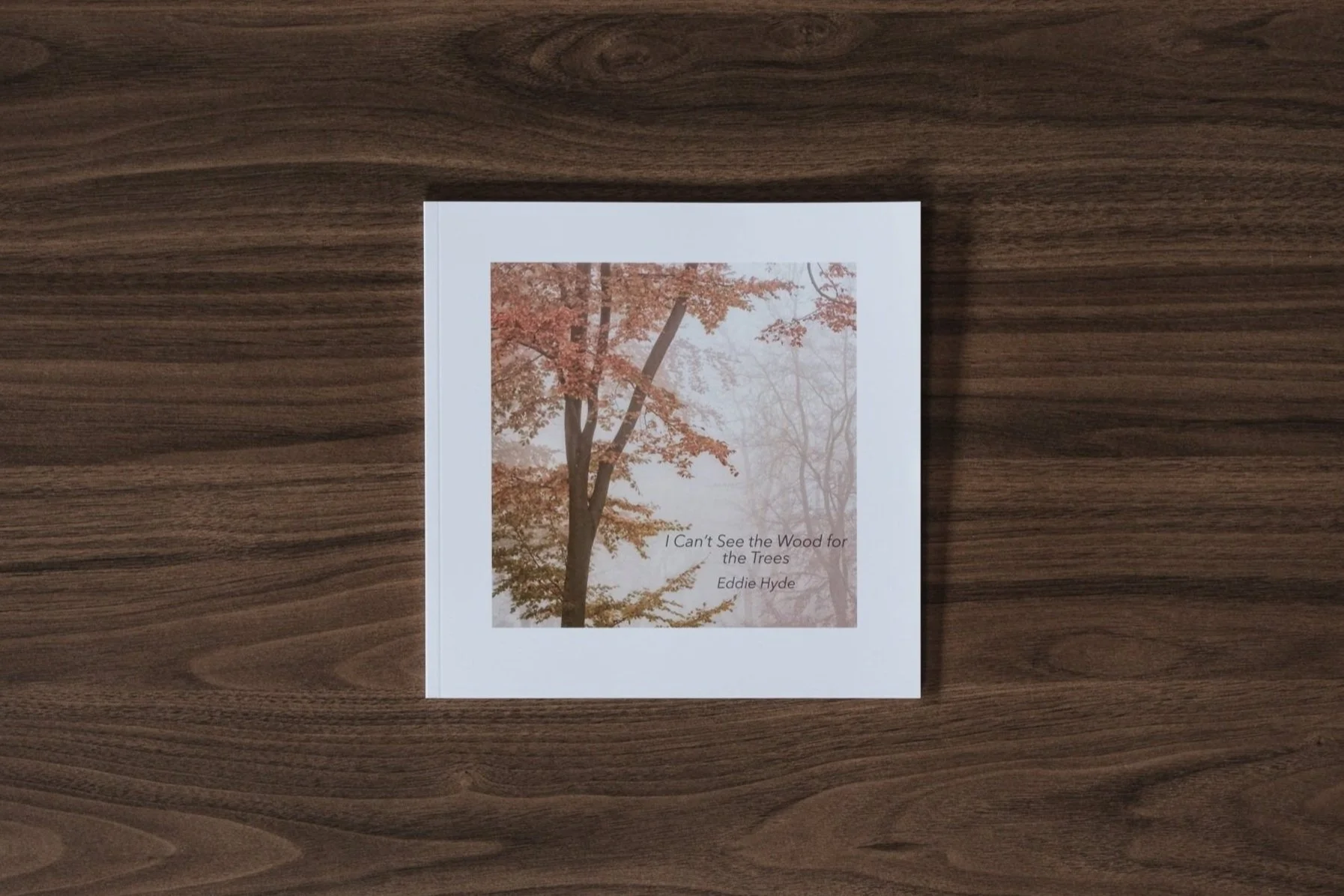
A woodland photography book by Eddie Hyde, featuring beautiful images of the Surrey woodland
Eddie Hyde is a photographer based in Surrey, and UK. In 2024, I attended an exhibition he co-hosted with Vanda Ralevska, showcasing some of their beautiful landscape photography. While there, I picked up this self-published photobook by Eddie titled I Can’t See the Wood for the Trees, which features a selection of his beautiful woodland images.
Author’s Synopsis
Just to note, I couldn’t find this book on Eddie Hyde’s website, so this is an extract from the book’s introduction.
I have always had a strong affinity for nature and woodland. The range of sensations within a wood brings a sense of wonder, comfort and peace. In Japan, they call it Shinrin-Yoku: taking in the forest atmosphere or “forest bathing”.
Living in Surrey, which has the most trees of any county in England, I am in easy reach of many of these woodland areas and visit them almost daily, most often in the early morning or late afternoon when the light is at its best. For me, being amongst the trees is calming, invigorating and therapeutic. I love to search for order in the chaos.
In this booklet, I hope to share with you this experience and to show the beauty to be found in my local woods.
My thoughts about the book
This modestly sized softback book opens with an introduction by Eddie Hyde, in which he explains his interest in landscape photography and his connection to woodland, particularly in Surrey. When you turn the page, the first woodland photograph appears, setting the focus for the rest of the book.
There’s something deeply satisfying about focused photobooks that explore a single subject or theme in depth. Showcasing the beauty of the Surrey woodland (home to more trees than any other county in England), these smaller, carefully crafted monographs allow the photographer to immerse themselves fully in their subject. I especially appreciate this approach because it gives the author space to reveal what truly draws them to the subject, capturing nuances and moods that broader collections might overlook. For me, such books offer a richer, more intimate connection to the place and the artist’s vision.
Regarding the design, I appreciated the sequencing, which helps the eye flow effortlessly between the pages, and the use of a square crop on each page suits the individual compositions well, giving the book a consistent and balanced look. The images, mostly taken during autumn and winter, are stunning. While including spring and summer scenes might have added a little more variety, leaving those seasons out perhaps opens the possibility for a future volume.
I’m not entirely sure of the paper specification, but each page has a pleasing weight and appears to use a soft-sheen, lustre-like finish, which I feel suits the mood of the work perfectly.
I’m pleased to have discovered Eddie’s book while visiting the exhibition. If you’d like to own a copy, I recommend contacting Eddie via his website to check availability.
Book Details
Soft cover book
Size: 21cm x 21cm
Pages: 46 pages
Availability at the time of writing: I looked on the author’s website to find out more about this book’s availability, but it was not mentioned. I recommend contacting Eddie via his website to check availability. https://eddiehydephotography.zenfolio.com
Until next time.
Trevor

Reflected Light - Volume One by Ben Horne | My Photo Bookshelf
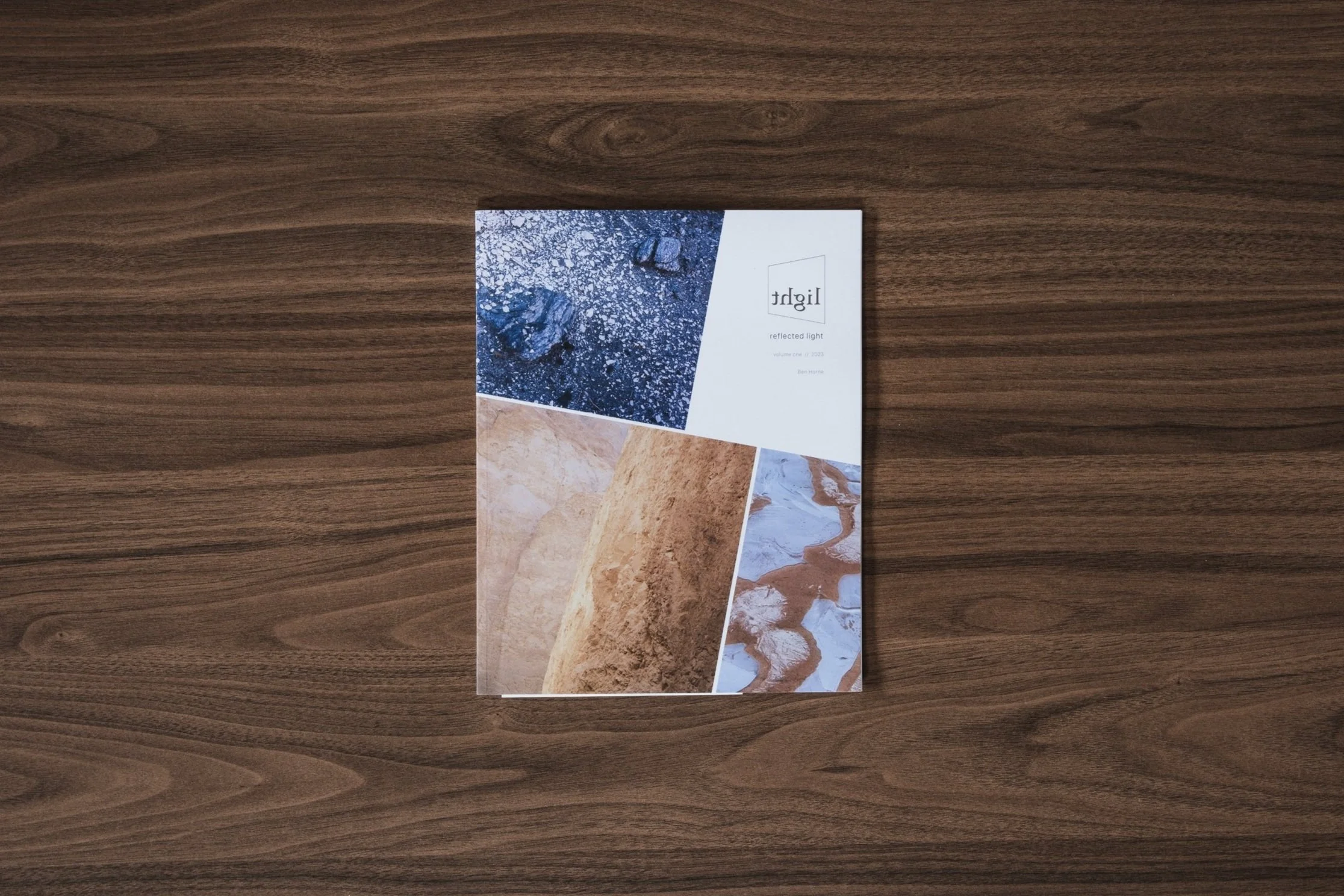
The first in Ben Horne’s Reflected Light zine series features large-format film photographs from one of his seasonal outings to Zion, Death Valley, and southern Utah.
If you weren’t already aware, Ben Horne is a large format landscape photographer from the United States, best known for his beautifully composed, carefully crafted images captured on 8x10 film.
I’ve followed Ben’s work for a few years now, primarily through his YouTube channel and website, and I’m a big fan of both his photography and how he approaches his craft. I’ve already bought one of his books with my own hard-earned cash — Between the Wind, published by Kozu Books, but, Just to be fully transparent, I received volume one of his Reflected Light series as a gift, along with a book by Guy Tal (another one to read and review here), as a competition prize from a podcast Ben used to host called Creative Banter.
Author’s Synopsis
Included in this zine is my favorite work from 2023, spanning my two winter trips, my spring trip, and my fall trip. Each photo is accompanied by text, along with information about the film, camera, and lens used.
My thoughts about the book
First of all, the zine itself. Printed on satisfyingly heavy, uncoated recycled paper, it feels great to flick through, and the photos, with their matte finish, look fantastic on the page. It’s a perfect example for anyone who doubts the quality of lower-cost zines compared to traditional photo books.
Inside, the zine opens with a short introduction by Ben and then goes straight into the images. Presented in various orientations and sizes, he’s done a great job adding variety to how the photos appear on the page, which makes the book flow beautifully. I particularly like the full-bleed portrait images; printed at 8x10 inches, they’re shown at their native size, so I get to experience them much like viewing the original film.
Alongside each photo are technical details like the film used and exposure settings, and nearly all are paired with a “behind the lens” story. These add great context, offering insight into what drew Ben to the scene, how repeated visits paid off, and the subtle compositional choices that made the final image work.
I mentioned above that I received this zine as a gift from Ben, but I strongly believe that artists should be supported, and alongside buying his first book, Between the Wind, I have since purchased a copy of the sequel to this Reflected Light zine, and will post my thoughts on that one at a future time.
This edition is now sold out, but if you’re only just discovering Ben’s work or this zine series, I’d recommend subscribing to his newsletter and keeping an eye out for the next release.
Book Details
Soft cover zine
Size: 8” x 10”
Pages: 32 (18 images) - 100% recycled uncoated paper stock
Availability at the time of writing: Out of stock, but in the unlikely event this zine is reprinted, it will be available on Ben Horne’s website here: https://www.benhorne.com/store
Until next time.
Trevor

Venice in Solitude by Christopher Thomas | My Photo Bookshelf
A beautifully crafted book by Christopher Thomas, featuring 83 city portraits of Venice taken on Polaroid Type 55 film.
There’s something undeniably captivating about film photography, and even though I shoot digitally, I’ve always been drawn to its timeless quality. I follow the work of many photographers who shoot on film, and I find myself constantly inspired by the nostalgic mood it evokes. While I haven't yet explored film myself, I hope to one day have the time and patience to experiment with it. So, when I discovered Venice in Solitude by Christopher Thomas—a beautifully crafted book of black and white film photography capturing one of my favourite cities, it felt like a natural addition to my collection.
Synopsis
From the lonely, rain-swept piazzas to silent rows of empty gondolas, one of the world's busiest and most beautiful cities lies frozen in time in this stunningly illustrated book that captures the city without people. Whether you're a first-time tourist or seasoned traveler, it's virtually impossible to find yourself alone in Venice. The city's many architectural splendors, its winding canals, ancient piazzas and charming markets are marvelous to visit--and crowded with people in every season. In these hauntingly beautiful photographs, Crhistopher Thomas takes readers on a solitary tour of the city Lord Byron once called "the Most Serene Republic."

As he did with his previous volume, New York Sleeps, Thomas uses long-term exposures and a now discontinued large-format Polaroid film to capture places bereft of humans in the early hours of the day. Readers can almost feel the ghosts of Titian, Shakespeare, Vivaldi, and Henry James wandering these canals and cobblestones; and they can experience the city as it was intended to be: an ingeniously planned, aesthetically delightful oasis of beauty, light, shadows--and serenity.
My thoughts about the book
In 2010, Christopher Thomas temporarily set up home in Venice, embarking on a new photographic project, capturing 100 pictures using his large-format Linhof Technika camera, a selection of lenses, a tripod, a dark velvet cloth, and many boxes of Polaroid Type 55 film. This book features 83 of the photos Christopher made.
The book itself is beautifully produced, bound in linen with one of Christopher Thomas’s photographs—showing a row of gondolas—featured on the front cover. This image offers a fitting preview of the photographic style and atmosphere found throughout the book (more on that later). Inside, the book opens with another image leading into an introduction written by Ira Stehmann, an editor and co-editor of numerous fine-art photography books. In the introduction, Stehmann discusses Thomas’s background, his photographic approach, and the equipment used for the project. She also reflects on the work as a whole, exploring the choice of subjects and the feelings of enchantment and surrealism it evokes—sentiments I strongly share when viewing these images.
Accompanying the photographs is a collection of poems by Albert Ostermaier, a contemporary poet from Munich, Germany. I consider myself a novice when it comes to poetry, and while I found some of the pieces a little difficult to fully grasp, they add an intriguing and thoughtful layer to the book. Overall, the poems are a welcome addition, complementing the mood and tone of the photography effectively.
The images are presented almost exclusively one per spread, surrounded by generous white space, occasionally interrupted by a title or a poem. Second only to the photographs themselves is the way they are displayed—uncropped, with the rough, original film borders left intact. As someone once described it, “a perfect negative surrounded by an imperfect frame” (a line I’ll admit I borrowed from Wikipedia). I love this approach, as it lends a timeless quality to images of a timeless city.
While I admire every aspect of how this book is presented, it’s the work itself that truly matters—and it does not disappoint. These city portraits are wonderfully varied, ranging from classic views of Venice to hidden corners that would be difficult to find without a local’s knowledge. To capture the true essence of Venice in any medium, both the well-known landmarks and the lesser-seen places must be included, and I believe this body of work succeeds in doing exactly that.
If you love Venice, classical architecture, black and white imagery, and the unique character of film photography, this book delivers all of that and more. It’s a beautifully crafted tribute to one of the world’s most enchanting cities.
Book Details
Hardcover
Size: 300mm x 280mm
Pages: 160
Availability at the time of writing: Available from the author’s website here: https://www.christopher-thomas.de/product/venice-in-solitude
Until next time.
Trevor

This Pleasant Land | My Photo Bookshelf
An exploration of Britain through a collection of photographic projects telling just a few of the many stories of what shapes this unique landscape.
Over time, I’ve found myself more and more drawn to the British landscape. At some point, I realised that no one person can truly see and photograph it all — at least not properly. And honestly, I’m okay with that. These days, I’m more than happy to explore this country I call home through the eyes of the many talented photographers who are just as passionate about capturing its beauty and diversity.
This Pleasant Land brings together 24 small photographic collections. Each one is different in subject, but they all share a common thread: every collection tells its own unique story about the British landscape in one way or another.
Synopsis
24 photographers capture Britain today.
The British Landscape is changing. Geographically, politically, even emotionally, the boundary lines of Britain - and what it means to be British - are in flux. This book looks at the new terrains, memories and myths of this contemporary landscape through the eyes of some of the world's most exciting photographers.

My thoughts about the book
The book, written by Rosalind Jana, an arts and culture writer based in London, starts with an interesting and insightful introduction, exploring the deeper meaning of photographing the British landscape. Referring to some of the projects that feature in the book, Rosalind talks about the many connections and motivations that inspire their creation, such as childhood memories, political context, and even those who simply want to represent the subject as a visual point of interest.
After the introduction, the first of the 24 projects begins, each one paired with a short piece of writing that adds a bit of context to the photos that follow. All the featured projects were shot within the last 20 years, making this book a contemporary, 21st-century snapshot of the British landscape.
Each project in the book tells a unique story — from the way humans shape the landscape and how natural and man-made elements interact, to a series of abstract cyanotype prints made along the Dumfriesshire coast. There’s a collection focused on seaside holiday resorts, and another featuring powerful portraits of female farmers working the land in Scotland. And that’s just scratching the surface. This book takes you on a photographic journey across Britain, weaving together stories of art, beauty, history, and politics.
If you’re someone who prefers a more traditionally picturesque view of the landscape, this book might not resonate as much as some of the others I’ve shared in the Photo Bookshelf series — and that’s totally okay. But if, like me, you’re drawn to the variety of projects, the stories behind them, and the motivations that drive them, then I’d definitely recommend picking up a copy for yourself.
Hoxton Mini Press is an independent book publisher based in London. Although this was the first book of theirs I purchased, I’ve since spent countless hours exploring their extensive catalogue. The book has a traditional, high-quality feel, and the combination of compelling writing and striking imagery made it an incredibly enjoyable read.
Book Details
Hardcover
Size: 237mm x 285mm
Pages: 224
Availability at the time of writing: Available from the Hoxton Mini Press website here: https://www.hoxtonminipress.com/products/this-pleasant-land
Until next time.
Trevor

Seascapes by Nigel Danson | My Photo Bookshelf
Nigel Danson's Seascapes, the third book in his series, beautifully captures the dynamic and ever-changing coastal landscapes through a stunning collection of photographs.
Author’s synopsis
Throughout this book you will see that I have tried to capture the essence of why I love being on the coast and by the sea. A massive part of that is how the sea interacts with the land. I am fascinated by this connection and how the sea has shaped the landscape through constant erosion and pounding of the rock, sand and salt water.
I share my favourite seascape images and talk about why I photographed them, how I composed them and the cameras and settings I shot them with.

Seascapes are the most dynamic of all forms of landscape photography. In this book I take you on a journey of discovery of coastal views, stunning beaches and epic waves. These images all hold a special place in my heart.
My thoughts about the book
Keeping the familiar design of the trilogy, Seascapes features the same cloth finish and foil lettering as Vistas and Woodlands, a detail I really appreciate. The book has a high-quality look and feel, perfectly complementing the photography inside.
The book opens with an introduction by Nigel, where he reflects on his connection to the sea and coast, shaped by childhood memories. This resonates with me, as much of my photography is driven by a deep sense of connection and nostalgia, and I can appreciate the desire to create work that goes beyond aesthetics and holds personal meaning. I guess there is a stronger authenticity to work created in such a way.
The book is divided into chapters: Coastal, A Wider View, Waves, and Abstract, and each starts with a brief paragraph in the way of a small introduction to the topic. As expected, the photography throughout is outstanding, showcasing a wide variety of work that makes for a compelling and diverse exploration of the book’s theme.
Nigel is one of the UK’s most highly regarded and accomplished landscape photographers, a reputation built not only on his exceptional skill and talent but also on his dedication to his craft. His success is not just a result of his ability behind the camera but also the time, effort, and passion he invests in projects like this book. His commitment to creating high-quality, thoughtful work is what truly sets him apart.
Book Details
Linen cloth Hardcover
Size: 300mm x 240mm
Pages: 128 litho printed pages on 200gsm silk art, FSC sustainably sourced paper
Availability at the time of writing: Limited edition still available from Nigel Danson’s website here: https://www.nigeldanson.com/products/p/seascapes
Links to my review of the other two books in the series can be found below:


Until next time.
Trevor

Land by Fay Godwin | My Photo Bookshelf
Land by Fay Godwin is the superb result of a decade-long photographic project to capture an unfiltered view of Britain’s diverse landscapes
As I delved deeper into the history of landscape photography, it was inevitable that I would come across some of the most well-known American photographers, such as Ansel Adams and Edward Weston. But what about the iconic British landscape photographers? Of course, we have David Ward, Charlie Waite, and my personal favourite, Joe Cornish—all still actively practicing landscape photography. However, in the same breath, one must also recognize Fay Godwin, one of the few professional landscape photographers of her time.
Fay Godwin travelled across the UK, documenting its landscapes through her lens. In 1985, she released Land, a book featuring photographs primarily taken in the preceding decade. This book and its accompanying exhibition cemented her status as one of the UK’s most treasured landscape photographers.
Author’s synopsis
This magnificent collection of photographs is a unique celebration of the British landscape by one of the finest landscape photographers of our day. Combining documentary realism with a poetic instinct, elemental forms with visual irony, Fay Godwin brings a distinct and individual vision to her work.
Paying tribute to the achievement of a ‘true artist’, the novelist John Fowles makes his own eloquent statement on art and the landscape in his penetrating essay.

My thoughts about the book
While researching Fay Godwin’s work, I came across the video I’ve linked to below, and one thing Fay talked about that stuck with me was her take on landscape photography and her dislike for the blue sky, green grass, “postcard” scenes. Fay tried to portray a “real” view of Britain’s landscape, sometimes picturesque, sometimes bleak, but always natural and always honest.
‘Land’ starts with a multi-page essay by John Fowles, followed by an introduction by Ian Jeffrey. From there, we get Fay’s photos. Taken over ten years, the pictures (kind of) flow geographically, starting up in Scotland, working down the UK, and ending with photos taken on England’s south coast. Along the way, Fay photographed various landscapes, some more picturesque than others, visiting locations such as the Scottish Highlands, Yorkshire, Wales, Wiltshire and Kent.
It’s evident from the photos included that Fay had a remarkable ability to find beauty in a wide range of subjects. Some are familiar, such as the sweeping natural vistas of Glencoe and the Lake District, while others are more unconventional, like a close-up of a cobbled road in Yorkshire or a rusted car partially submerged in water in Kent. This diverse subject matter reinforces my belief that Fay was less concerned with adhering to traditional landscape photography conventions and more focused on capturing an authentic, unfiltered view of Britain’s landscape, one she openly admitted to finding far more compelling to photograph.
With such varied subjects, one might expect the sequencing to feel disjointed, but impressively, that’s not the case. The images flow seamlessly, a testament to Fay’s careful attention to the book’s layout.
Fay Godwin (17 February 1931 – 27 May 2005) was a British photographer known for her black-and-white landscapes of the British countryside and coast.
Along with the video, this book has reminded me that landscape photography isn’t just about finding picturesque views of the world around me. It’s about capturing something I find interesting, regardless of social norms and by doing this, I can create a more honest and unique body of work.
Book Details
Softcover
Size: 260mm x 260mm
Pages: 160
Availability at the time of writing: Unavailable from the usual UK booksellers. Consider buying a used copy.

Wish You Were Here by Vanda Ralevska | My Photo Bookshelf
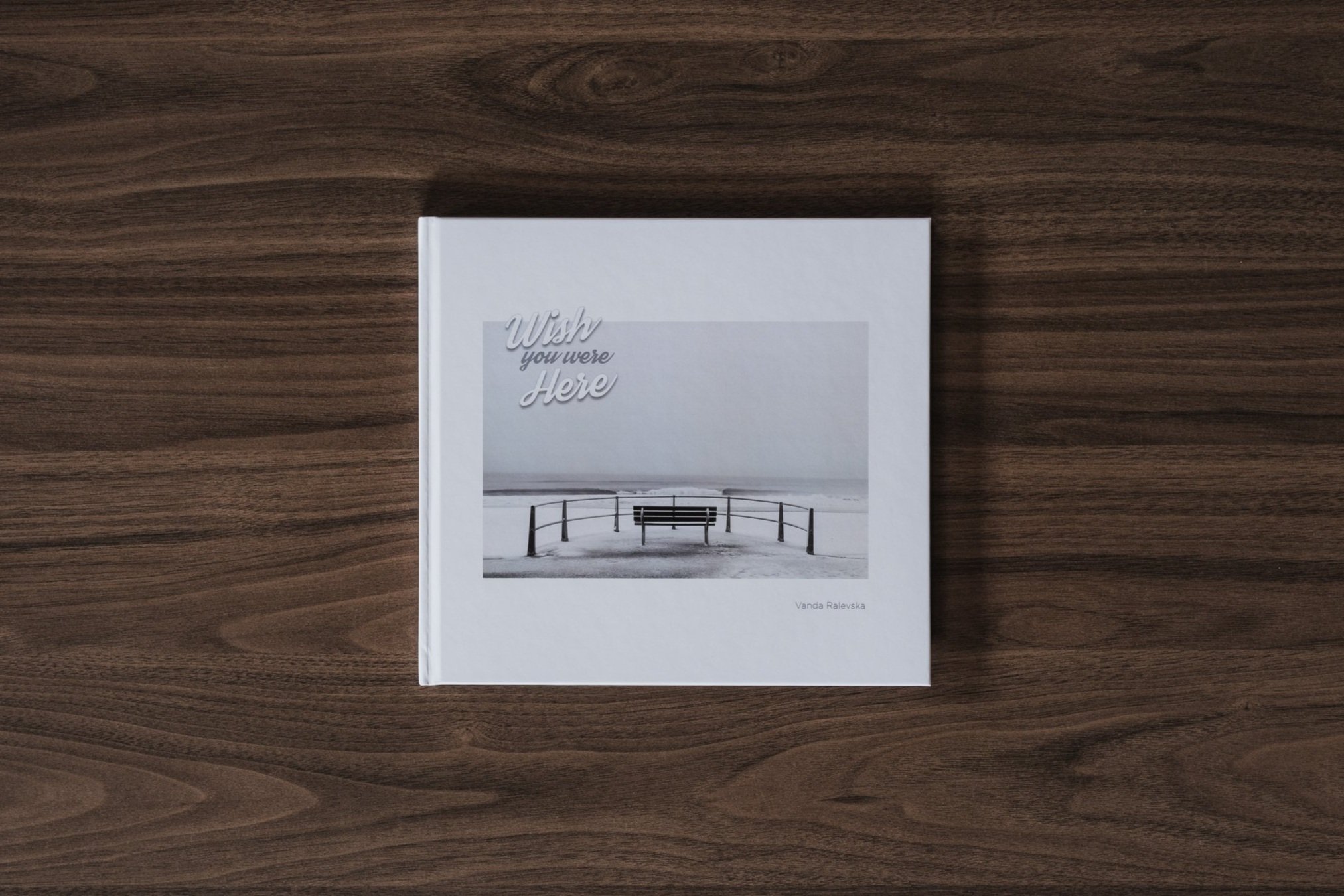
A companion book set created by Vanda Ralevska featuring a collection of photos of the iconic British seaside.
I’ve always loved spending time by the British seaside in the warmer months. I love the energy, the vibrancy and who doesn’t love eating a traditional fish and chips on a deck chair while staring out to sea? But, as I’ve grown a little older, I’ve started to visit the coast more often in the colder (and wetter) months. Nothing beats grabbing a hot coffee and having a relaxed wander along a quiet promenade with just the sound of the distant waves breaking on the beach.
So, when fellow photographer (and now friend) Vanda Ralevska released her Wish You Were Here book set featuring some outstanding photography of the British Seaside, I knew I had to purchase myself a copy.
Author’s synopsis
This companion book set explores the nostalgia of the English seaside throughout the seasons, from the sombre beauty of winter months to its restored splendour in the glorious days of summer.
There is a melancholy about the English seaside in winter. No matter what Mother Nature throws at it, there is a resilience that enables it to resurrect its full magnificence in summer months.
It goes into hibernation, it falls into slumber and sleeps dormant like a perennial plant, just to flourish when the sun and warmth come back.
Like trees that are bare and stark in winter. But in the summer they become beautiful, vibrant and everything we love about them.
What started as a pure fascination and attraction turned into a lifelong passion. There isn't any other place I would rather be than a beach. Though I enjoy the peaceful and quiet wintertime most, I find the bright and sunny weather as captivating as the bleak and gloomy days. Therefore, I felt I needed to capture both sides of the English seaside and separate them into two books that complement each other.
My thoughts about the book
First things first, and I’m not just saying this, but I love these books. The photos included are well-crafted, and expertly composed, with subtle seaside humour and ironies implied throughout. As I mentioned in the intro, I love both sides of the seaside experience, from the fun, warm, summery days to the calmer but much colder days in the winter and this companion book set encapsulates those experiences perfectly.

The book set is comprised of two books. Kiss Me Quick is fun, vibrant, and full of photos of blue skies and seaside colours. The pictures included are colourful but well-controlled and have an aesthetically pleasing but subtle high-key processing applied to them. The photos are all in square format, which, as you may have read here, is one of my favourite aspect ratios and works incredibly well for this collection.
The image sequencing throughout is, in my opinion, a bit of a master class and taught me a thing or two about how well a book can be pulled together. There is a good mix of clever, humorous, and more subtle pairings. I know first-hand that Vanda invested a considerable amount of thought into sequencing the images for both books and the results speak for themselves.
The second book, in contrast to the first, represents a more subdued, desolate seaside experience and with the lack of blue skies and vibrant summer tones, Vanda chose to process this collection in monochrome, which suits the work well. Having recently embarked on my own black-and-white journey with my Timeless City project, I felt a deeper connection and was able to appreciate this collection of work far more than I might have before when processing predominantly colour work.
Individually, these books hold their own as separate collections of photographic work, but putting them together as a single book set was a master stroke by Vanda as together, they tell the complete seasonal story of the British seaside that most of us in the UK have experienced at some point in our lives.
Book Details
Hardcover
Size: 210mm x 230mm
Pages: 140 (Wish You Were Here)/124 (Kiss Me Quick)
Availability at the time of writing: Available directly from Vanda’s website here: https://mylenscapes.uk/wish-you-were-here/

Journeys Into the Wild: The Photography of Peter Dombrovskis | My Photo Bookshelf
A book featuring the photographic work of the great conservationist, Peter Dombrovskis.
If one of my all-time favourite landscape photographers, Joe Cornish talks highly of any photographer, I take notice and after watching some videos a few years ago featuring Joe talking about the late Peter Dombrovskis and discussing his work, it quickly became apparent to me this was a photographer I needed to know more about.
Peter Dombrovskis was a landscape and conservation photographer known for taking pictures of Tasmanian wild places and was instrumental in preventing the damming of the Franklin River in the 1980s. Peter died in 1996 while photographing the Western Arthur Range in southwest Tasmania, but even now, 30 years later, he still has a strong following in the landscape photography community. After reading this book, I can see why.
Author’s synopsis
Journeys into the Wild is a poetic escape to a fragile and breathtaking wilderness, with celebrated photographer Peter Dombrovskis as your guide. Commentary and an extended introduction by Bob Brown allow readers to engage with the photographs on a deeper level.
Bob Brown and Peter Dombrovskis forged their friendship in the battle to save the Gordon and Franklin rivers. As a founder of the Wilderness Society, Bob organised the blockade of dam works on the Franklin, recruiting Peter and his iconic photography to make the case for conservation over profit.

During the campaign, Bob accompanied Peter on one of his kayak trips down the Franklin and observed his process as a photographer. Peter would go on to take one of the most famous photographs in Australian history, Morning Mist, Rock Island Bend, Franklin River, an image that featured in calendars and diaries across Australia and that was integral to the success of the campaign. The two remained friends until Peter’s death in 1996.
My thoughts about the book
I’m so glad I purchased a copy of this book because it tells such a compelling story about the power of passion, perseverance and photography, and how, when used together, they can bring about meaningful change for the better.
Created by former Australian politician and environmentalist Bob Brown, Journeys into the Wild tells Peter Dombrovskis’ story, about his emigration from Latvia to Australia when young, his first camera, the friendships he made and how all of that forged a path for him to become one of the most influential conservation photographers of his time His work was used in a campaign to help protect thousands of square miles of unspoilt Tasmanian wilderness and for that story alone, it’s a book worth reading.
Dombrovskis was equally known for his large format, landscape photography and this book includes much of his work, with a particular focus on the National Parks of Tasmania. From wide, landscape vistas such as the peaks of Cradle Mountain to close-up, intimate compositions of a leaf’s skeleton at Mount Mulu, this book is a feast for anyone who appreciates natural landscape photography. The Tasmanian landscape is incredibly diverse and quite different to what I see photographed today. Dombrovskis was able to tune into the finer details and record them on film so future viewers of his work would get a glimpse into how the national parks of Tasmania looked many decades ago and as a result of the work he and Bob Brown undertook, how those national parks thankfully, still look today.
I know I’m a relative latecomer to Peter Dombrovskis’ photographic party, and many who read this will already be aware of his work or have a copy of one of his books. Still, none of that matters, as after finishing this book, it’s clear that like many of the landscape photography greats, his story and accompanying work has and will continue to stand the test of time for future generations to discover.
Book Details
Hardcover
Size: 280mm x 220mm
Pages: 200
Availability at the time of writing: Limited availability in Europe but there are some about. I purchased my copy from https://www.abebooks.co.uk/.

The Great Wilderness by Alex Nail | My Photo Bookshelf
The Great Wilderness is a book by Alex Nail featuring some stunning pictures of Scotland’s most remote mountain area.
I’ve followed and admired Alex Nail’s mountain photography for a few years through his website, YouTube, and podcasts and although I missed out on Alex’s first book “Northwest” (still hope to own a copy one day), when The Great Wilderness was announced, I made sure to buy myself a copy.
Author’s synopsis
“The Great Wilderness” is a luxury hardback photography book of Scotland’s most remote mountain area. It shows the Highlands during ephemeral moments of light, weather, and seasonal change. The images were captured over a 4-year period backpacking through the mountain areas of Fisherfield, Dundonnell and Letterewe. Alongside the images are stories of adventure in the mountains.
The book is designed, printed and bound entirely in the UK and uses the finest materials and production processes throughout. Depicting spectacular scenery in exceptional conditions, this book is for anyone who loves the outdoors.

My thoughts about the book
As I mentioned above, I missed out on owning a copy of Alex’s previous book, Northwest which has a chapter dedicated to The Great Wilderness, but as Alex mentions in his introduction, with so much to see and photograph there, a single chapter wasn’t enough. The Great Wilderness book project was born.
For those unaware (as I was), The Great Wilderness is a mountainous region formed of a small number of privately owned estates and in 2019, Alex set off on his multi-year adventure to photograph them.
The book starts with a wonderfully written foreword by one of the UK’s finest landscape photographers, Joe Cornish. Then on to Alex’s introduction, explaining more about the area, the reason for starting the project and a little about his photographic/editing ethos.
The pictures in the book are typically printed big with some panoramic images spanning both pages and this design decision helps portray (to a book’s best ability) the impact one might feel being there with Alex as he took the photo. I’m typically not a fan of pictures spanning the spine but I’ve since come to learn that in some situations, and with certain book designs it can work and this is one of them.
The image sequencing flows well and the book is organised by chapters, each featuring incredible photography from a different part of the region with names I won’t even attempt to pronounce and with the photos taken in different conditions with a range of compositional techniques used, by the time I had finished, I felt I had been shown a true representation of this fascinating landscape.
What a labour of love this book is. I really mean that. Not only is this book full of stunning mountain photography that would have taken huge amounts of time, planning and effort to create, but the book itself has been designed with so much attention to detail such as the choice of cloth for the cover, the beautifully written “on-location” stories and the incredible maps and illustrations created by Alex himself.
A fantastic landscape photography photo book and if it’s still available when reading this, I encourage you to pop over to Alex Nail’s website to buy yourself a copy.
Book Details
Hardcover
Size: 240mm x 300mm
Pages: 136 Litho printed pages
Availability at the time of writing: Available from the author’s website: https://www.alexnail.com/great-wilderness-book/

Photographs & Stories by Michael Kenna | My Photo Bookshelf
A special book looking back at 50 years of photography taken by Michael Kenna
I’ve long admired Michael Kenna’s pictures, but only recently since taking black and white photography more seriously in my own work did I start to study Michael’s photography more closely. I studied his work online and watched lots of video interviews, but I really wanted to see his work in print, so luck would have it that while I was looking into the books Kenna had published, he announced Photographs and Stories. This book caught my attention as it was a great opportunity to look back at his work spanning 50 years and I wasted no time popping it into my basket.
Author’s synopsis
In celebration of Michael Kenna’s fiftieth year as a photographer, we are thrilled to announce the publication of Michael Kenna: Photographs and Stories.
Kenna has selected one image for each year beginning 1973, when he enrolled in the Banbury School of Art, and for each subsequent year. Following the “Photographs” section is “Stories,” in which Kenna gives context to each image and considers how it connected to his own life at the time.
Michael Kenna is arguably the most influential landscape photographer of his generation. Often working at dawn or during the night, he has concentrated primarily on the interaction between the ephemeral atmospheric conditions of the natural landscape, and human-made structures and sculptural mass.

Over ninety books and catalogs have been published on his work. His exquisite, hand crafted, silver gelatin prints have been exhibited throughout the world and are included in such permanent museum collections as The National Gallery, Washington, D.C.; The Shanghai Art Museum, Shanghai; and The Victoria and Albert Museum, London. In 2022, Mr. Kenna was made an Officer in the Order of Arts and Letters by the French Ministry of Culture.
My thoughts about the book
First off, I love how this book has been presented. It oozes class. The cloth cover, the stunning cover picture, the foil lettering and best thing of all, the Japanese Kasadaka paper inside. It’s a thick, warm matt paper that fits with Michael’s monotone work perfectly. It looks amazing and feels even better to touch.
The book opens with a foreword by Ann Jastrab, Executive Director, Centre for Photographic Art in CA and then flows straight into Michael’s pictures. As you can imagine the photos included are incredible and with them sequenced in chronological order, one thing that stands out to me is how Michael’s style has remained so consistent over the years. To stay true to one’s artistic vision, shrugging off contemporary trends and the lure of modern camera equipment must take significant amounts of self-belief. There was, however, one conspicuous shift in style and that came in 1989 when Kenna transitioned to the square format. From this point in the book, all of the photos were in a 1:1 aspect ratio.
While studying photobooks over time, I’ve started to learn what I think works and what doesn’t (for me) and one of those things I do like with regards to design is to keep the photo pages clean and uncluttered with minimal text and this book is a perfect example of that. Under each image is just a few words detailing where and when the picture was taken, but the stories behind each photo are printed toward the end of this fine book. This approach is fast becoming one I prefer the most when there is a story to be told about the image and is a great compromise between letting the pictures breathe on the page whilst still ensuring their stories can be told.
This book is special. While reading it I enjoyed a delightfully visual and tactile experience and because of that, it gets elevated right up there as one of my favourites.
Book Details
Hardcover
Size: 11.5 x 13 inches
Pages: 106
Photos: 51 duotone plates printed on Japanese Kasadaka paper
Availability at the time of writing: Back in print. Available from https://www.setantabooks.com

Gathering Time by Simon Baxter | My Photo Bookshelf
A book featuring the work of woodland photographer Simon Baxter.
If you visit my website regularly, then it will be no secret that I love woodland photography and have been actively taking photos of trees for a few years now, so when Simon Baxter, one of the most talented woodland photographers out there releases a book, it automatically has a place on my bookshelf.
Author’s synopsis
‘Gathering Time’ is a photographic book by professional woodland photographer, Simon Baxter. It expresses the calm, quiet awe and emotion of woodland, as well as Simon’s unique connection to this beautifully complex world. Driven by the freely available therapeutic benefits of nature close to home, Simon has spent several years crafting woodland images to communicate his fascination with trees and appreciation for the sanctuary their home has provided.

My thoughts about the book
Gathering Time was released a few years ago and although I’ve just got around to posting about it here, it’s a book I’ve owned for some time and often flick through when in need of some inspiration. It’s one of those rare photography books where you will struggle to spot any filler images as every one in there is of such a high quality and very much deserves its place in the book (can you tell I’m a fan of his work yet?).
The book starts with a wonderfully written forward by Joe Cornish (another of my landscape photography heroes), followed by the book’s introduction. Simon’s introduction tells the story of what led him to photograph the woodland and the many benefits it brings. Amongst the beautiful woodland imagery are a scattering of essays, each telling a story, recalling memories or providing a window into Simon’s thought process. It’s a clever and insightful way to organise the book and group the photos together both visually with the sequencing and conceptually with the writing.
I’m a big proponent of using photography and nature to help improve mental well-being and Simon writes openly about his own, personal struggles both physically and mentally and how surrounding himself with the natural world went a long way to support his physical and mental healing.
I’ve spent many hours flicking through the pages of this beautifully crafted photography book and if you appreciate high-quality woodland imagery as I do, then Gathering Time should be at the very top of your photography book wishlist.
Book Details
Hardcover
Size: 300mm x 240mm
Pages: 128
Photos: 90
Availability at the time of writing: Still in print. Available from the author’s website: https://baxter.photos/shop/gathering-time

Fieldwork by Finn Hopson | My Photo Bookshelf
A landscape photography book by Finn Hopson featuring a collection of photos taken of the South Downs National Park in the southeast of England.
Being local to Brighton and the South Downs in the UK, I’ve long followed Finn Hopson’s landscape photography, admiring his photos of the Sussex Coast and the surrounding area both online, and when in the local area, visiting his gallery along the Brighton seafront to see his work in person.
It was during one of those visits to his Gallery when I picked up Fieldwork; the first of a trio of books Finn plans to release featuring the photos he has taken in and around Brighton and the South Downs.
Author’s synopsis
How many ways can you look at the same thing and see something different? How many times can you visit the same place and find something new?
“Fieldwork is the result of twelve years spent collecting different versions of the same thing. It’s a scrapbook of shapes, patterns, colours and light which define the South Downs. My approach is not about finding a singular ‘decisive moment’ but instead deciding to be there for as many moments as possible. This is a place that speaks to me more deeply than anywhere else, and this is my attempt to compile a kind of visual dialect to describe it.”

The book features more than 100 photographs of the South Downs, accompanied by a selection of words from the ancient Sussex dialect which evolved to describe some of the subtleties of this unique landscape.
”These pictures are not a definitive collection of iconic locations, or a compendium of must-see spots. Instead, my hope is that others who know the Downs will recognise something of their own experience, and those who are yet to visit may feel somewhat intrigued by the prospect.”
My thoughts about the book
As mentioned in the synopsis above, this isn’t a book full of iconic, recognisable views of Sussex, but a collection of well-crafted, photos of some of the many beautiful views of the South Downs taken during countless visits to this ancient landscape. In traditional style, the book starts with an introduction written by the author and in Fieldwork, Finn talks about his connection with this landscape, providing the perfect backstory to his book.
After the introduction, the book gets straight into the pictures of the South Downs, perfectly depicting the natural and man-made geometric shapes in the landscape. With only a scattering of words from the ancient Sussex dialect providing convenient places to pause throughout the book, the design is clean and uncluttered; just the way I like it.
Maybe it’s because I know this landscape well, but what I particularly like about the work in this book is how at first glance, it’s made up of a collection of impressive photos of the landscape but as you flick through the pages, you start to see a deeper story being told in the work. The South Downs is a hive of activity with walkers, workers, animals and various forms of agriculture and Finn has subtly included much of this activity throughout the book, which not only helps to portray the impressive scale of the landscape but tells a deeper story about how important the landscape is to so many.
This is a well-sequenced, high-quality photography book and even if you’ve never visited the South Downs before, this expertly crafted collection of photos is still able to take you on a journey through what is an incredibly unique and captivating landscape in the southeast of England.
Book Details
Hardcover
Size: 300mm x 240mm
Pages: 144
Photos: 105
Availability at the time of writing: Still in print. Available from the author’s website: https://www.finnhopson.com/photobook-products/fieldwork

At The Edge Of Permanence by Gill Moon | My Photo Bookshelf
The Edge of Permanence is a photobook by Gill Moon, featuring a range of pictures from a week-long photographic study of Coigach, a peninsula in the Northwest Highlands of Scotland.
The Edge of Permanence is a photobook by Gill Moon, featuring a range of pictures from a week-long photographic study of Coigach, a peninsula in the Northwest Highlands of Scotland. Gill is a landscape photographer and author based in Suffolk, England. I’ve followed Gill’s work for quite some time and was pleased to be able to buy number 5 of this limited run of 50 photography books.
Author’s synopsis
Nothing in life or the landscape is permanent.
We live life in moments, ephemeral and transitory, happy and sad, difficult and rewarding. The same is true of the landscape – it changes all the time.
But there are locations that have a durability about them that makes them feel unchangeable and permanent. Coigach in the North West Highlands of Scotland is one such place.
Coigach lies about 20 miles north of Ullapool in the North West Highlands Geopark. The landscapes within the park contain some of the oldest rocks (3 billion years old) and some of the earliest evidence of life found anywhere in Europe.
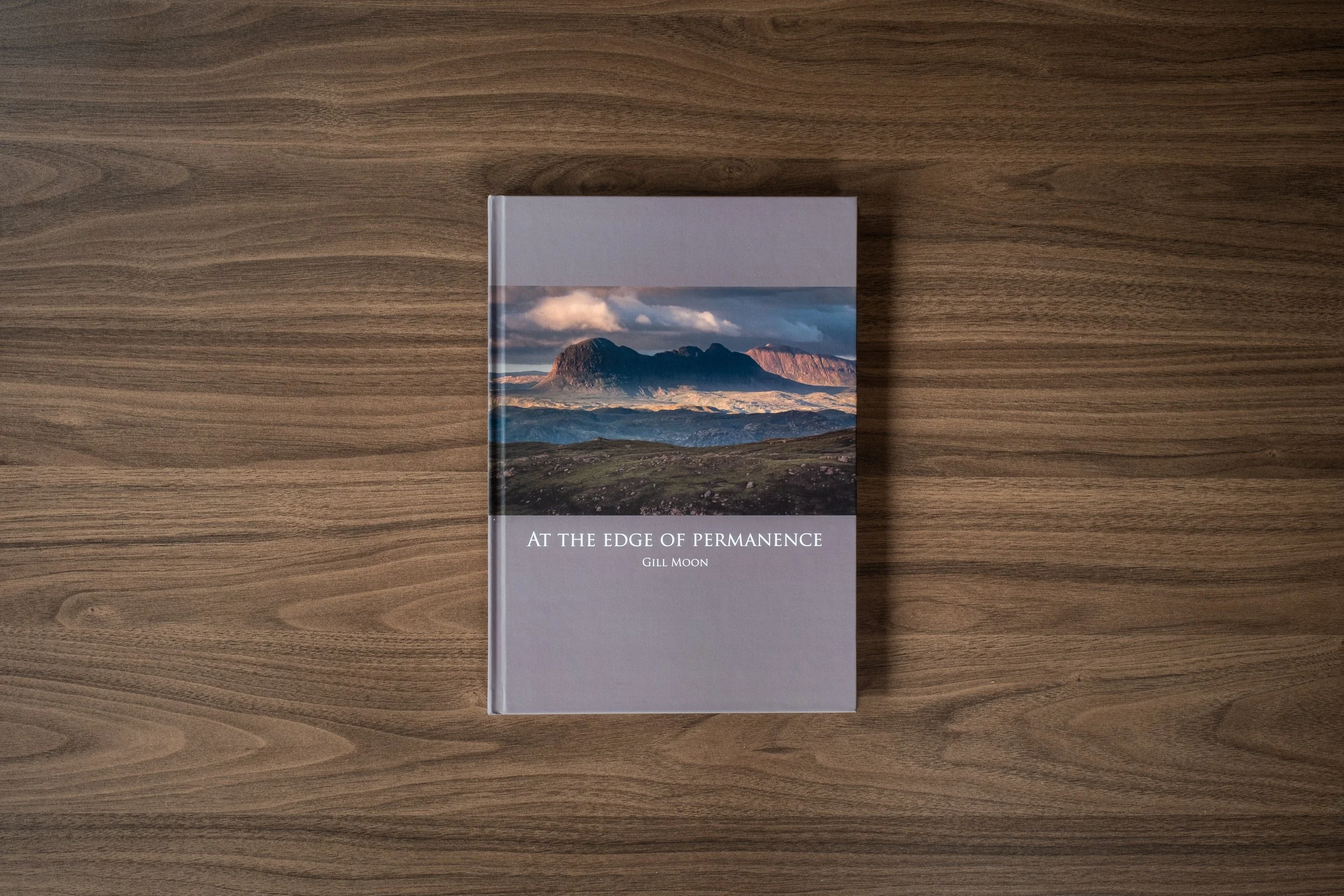
But on a more local level the area is made up of habitats and wild places that are transient and vulnerable and which change on a daily basis. Set against the seemingly permanent mountains of Assynt This project explores life in the liminal zones. Those ever changing realms where no moments are the same.
Although I have been to Coigach several times, in both summer and winter, I felt it was important for the images to represent as short a time frame as possible. For me this gives the most intense feeling of change. All the images in this project were taken during the course of one week in June 2022. They come together to form my observations of an amazing place.
My thoughts about the book
One of the many things I like about Gill’s work is how varied her work can be, from wide, uncluttered coastal vistas to smaller, intimate scenes and this book is a great example of that. For me, it’s the varied body of work that sets this book apart as a photographic study rather than just a book of pretty photos. Not only has Gill photographed those epic landscapes which would draw the attention of most of us, but she has also looked much deeper into the landscape, isolating some of the unique subjects and textures one could easily overlook. Regardless of the subject, all the photos have what I consider to be Gill’s distinctive style, from carefully composed, uncluttered compositions to high quality and consistent post-production.
The book itself is well presented, with thoughtful image sequencing throughout. The subjects and tones across the various page spreads complement each other well and the flow throughout the book feels smooth and deliberate. The weighty, matt paper suits the work well and feels appropriately tactile while thumbing through the pages.
Gill also includes seven or eight poems in her book, each written to accompany the photo on the opposing page. I’ll assume Gill wrote these as I didn’t see anyone else credited. I’m no poem connoisseur but I know what I like, and I like that these poems were included. Not only did I enjoy reading them as they helped me connect further with the work, but their inclusion provided a nice opportunity to pause to consider the work.
I very much enjoyed reading this book and love the photos Gill has included. If there happens to be any left at the time of reading, do consider popping over to Gill’s website to buy yourself a copy.
Book Details
Hardcover
Pages: 80 pages printed on 200gsm matt paper
Availability at the time of writing: In stock and available from Gill Moon’s website here: https://gillmoon.com/product/at-the-edge-of-permanence

Trees - A Photographic Exploration by Gary Turner | My Photo Bookshelf
An A5 zine celebrating the wonder of trees, featuring 40 captivating photos by photographer Gary Turner
After listening to Gary Turner speak about his photo book projects with Euan Ross on the In Discussion podcast over at https://biblioscapes.com, I popped over to Gary’s website and picked up both his Long Exposure zine and this one he calls Trees, A Photographic Exploration.
Author’s synopsis
A beautifully curated collection of black and white and colour photography of trees.
More than 40 photographs, carefully arranged across 24 pages, allowing you to explore the subtle details of trees and their setting in the British landscape.

My thoughts about the book
Let’s cut to the chase. I really like this book. Being just 24 pages and A5 in size, it seems a simple concept but when you start to read it, you quickly realise it goes far deeper than that. I admit, having a mutual admiration for trees means I approach this review somewhat biased, but something about this book connected with me.
There are 40 photos, all featuring trees and within the collection, so much is represented. The book starts by celebrating the form and composition of the tree with a collection of black and white photos transitioning to colour photos for the second part of the book with all of the seasonal tones represented. Throughout the book, there are portraits of trees, landscapes featuring trees and intimate photos with creative use of depth of field.
A particularly nice touch was to interweave extracts from Rudyard Kipling’s poem, “The way through the woods”. A fitting addition to such a lovely little book.
Book Details
Softcover
Size: 210mm x 148mm
Pages: 24 printed on 200gsm silk paper
Availability at the time of writing: In stock and available from the author’s website here: https://www.shutterspot.co.uk/product/trees-a-photographic-exploration-zine/

Working The Light | My Photo Bookshelf
Published in 2006, Working the Light provides an invaluable insight into the thinking of three of the UK’s leading landscape photographers.
Alongside newly published books, I also enjoy picking up older, usually second-hand photography books. I like to look back and enjoy the earlier work of my favourite photographers and read about their approach to photography back in the day. Working the Light was first published in 2006 and features three of the UK’s most well-known landscape photographers; Joe Cornish, David Ward and Charlie Waite. I bought this book to feel inspired, to learn from their critiques, and to find out how they went about taking photos almost two decades ago.
Author’s synopsis
Working the Light offers readers a unique chance to participate in a masterclass with three of Britain’s leading practitioners and teachers of landscape photography. Alongside a portfolio of their latest work, Charlie Waite, Joe Cornish and David Ward write about the genre for which they are best known: how they came to it, what inspires them, their current projects and the directions in which they see their work developing - for example, what role might digital play for any of these lovers of film?
Each of the three section of the book explores the theme of ‘working the light’ - surely the most critical and challenging aspect of landscape photography - with Joe Cornish writing about Wilderness Landscapes, Charlie Waite discussing Inhabited Landscapes and David Ward concentrating on inner landscapes.

Each section also contains a Gallery Workshop in which the trio critique images submitted by clients of the renowned travel company Light & Land, offering the kind of constructive comment and positive advice that one would normally only expect to get in the field.
Working the Light gives its readers a real sense of taking part in a location workshop with Waite, Cornish or Ward while also preserving their wisdom in permanent form that can be referred to in the future. Follow-up volumes are already planned, with the next in the series looking to explore the concept of Developing Vision and Style.
My thoughts about the book
It’s an interesting concept and one I like quite a lot. The book is made up of three chapters, each dedicated to one of the three aforementioned masters of their craft and each focused on a sub-genre of landscape photography. Within each chapter, you are taken on a bit of a journey, starting with a collection of photos and writing from each photographer, followed by a gallery of images submitted by previous clients of the Light & Land workshops and at the end of each chapter, Joe, David and Charlie offer their thoughts on those photos.
What I like the most about the book is that it’s not just about showing successful photos, but the three photographers also share what they consider unsuccessful images and write about how they might have been improved. This is important, as it teaches us that even those we consider the pinnacle of landscape photography are always learning and still need to work hard on their craft to take the best photos possible.
This book includes some thought-provoking quotes and useful tips for taking better images, and the critique offered to the submitted photos is both fair and respectful.
Even based on today’s standards, this book still holds its own and I thoroughly enjoyed reading it, drawing inspiration from the photos shared within.
Book Details
Hardcover
Size: 260mm x 234mm
Pages: 160
Availability at the time of writing: Unavailable from the usual UK booksellers. Consider buying a used copy.
A Year Amongst Trees by Brad Carr | My Photo Bookshelf
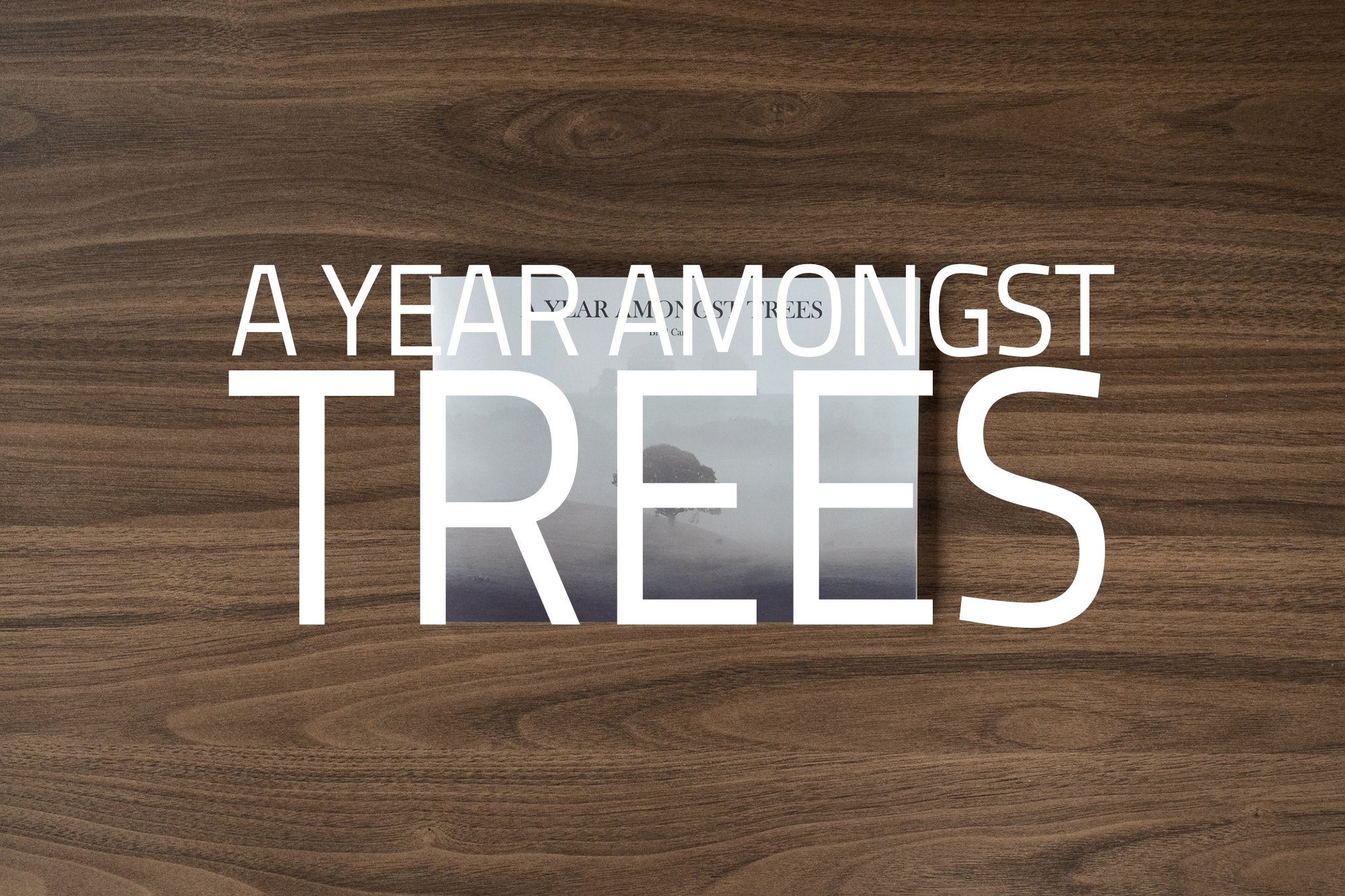
As the title suggests, A Year Amongst Trees by Brad Carr is the result of a 12-month project, photographing his local woodland.
Towards the back end of 2022, I was listening to a Biblioscapes episode featuring Brad Carr as he talked about his photobook featuring woodland photos he took over the course of a year back in 2021. He spoke about the project and his love for the woodland with so much genuine enthusiasm, I immediately went online and added his book to my collection.
Author’s Synopsis
This zine contains a collection of photographs from my 2021 portfolio and tells the story of a year which changed me as a photographer and human. Featuring a series of short stories, a poem that I felt inspired to write whilst out in nature, a little insight into why I create and where my love of the woodland was born.
There are stories to be told everywhere out there in nature. I hope that this zine inspires you to get out there and tell your own.

My thoughts about the book
When I picked this zine up for the first time, my initial impression was how good the soft touch cover felt in the hand. It has a luxurious feel to it, which adds so much to the overall reading experience. The book has a nicely written introduction, with childhood memories and a touching encounter Brad had with his Nan, which inspired much of his photography in 2021.
The book is jam-packed with beautiful woodland photography, and if you’ve followed me for any length of time, you will know that woodland photography is a subject I also have a strong connection with, making the overall reading experience even more special. The photos are overflowing with atmosphere and whether taken in warm, late summer light or on a cold, misty morning, Brad was able to capture that mood in his photos and unleash it via this book for us all to experience.
Alongside some of the photos, Brad included some stories which feature his thoughts about a particular photo or encounters he had while out in the field. There is a raw honesty and vulnerability in these stories and when I finished reading a page, I would find myself pausing, just to let the words sink in before moving on to the next page. This is a testament to how strong of a writer Brad is.
Overall, the book’s layout works well. The images were well-sequenced and flowed nicely with a good text-to-picture ratio. My only (very small and subjective) niggles were twofold. The first, and one I’ve mentioned before is when a picture spans more than one page. I can understand why it’s done, but for photography books, where the image is the main visual element, I find it very distracting. I also found having the paragraphs of text centre justified a little distracting. It may just be me, but it is harder to read, and I feel paragraphs of text should be left-justified. As I said, these are tiny issues.
Photography zines are typically less expensive and with it, carry lower expectations than a larger, more expensive coffee table book, but I think for projects like this and other smaller bodies of work, they are a fantastic way to get your work in the hands of others and should never be considered inferior. In a world where self-publishing has never been so accessible, I would love to see more landscape photographers use the zine format to help get their work printed and out in the world. Maybe I need to start taking my own advice.
Brad has a blog article to accompany his book here. He also has a YouTube channel centred around creativity, photography and nature.
This little book packs a big punch, oozing creativity from both the photos and the written word. If you can, do buy this gem of a woodland photography book.
Book Details
Softcover
Size: 210mm x 148mm
Pages: 52
Availability at the time of writing: In stock and available from Brad Carr’s website https://www.bradcarrphotography.co.uk/books-zines/a-year-amongst-trees-2021-zine.